An Interview with Mike Maggio
Co-produced by Elizabeth Bruce & Robert Michael Oliver

As part of our ongoing series of text interviews with writers, poets, visual artists, and other creative folk, Creativists in Dialogue is delighted to share this interview with friend and colleague Mike Maggio, who is both a fellow writer in the Washington metropolitan region and a Vine Leaves Press pressmate of Elizabeth’s.
NOTE TO READERS: If you, or a creative person you know, would be a great candidate for a text-and-image-only interview on our Creativists.Substack.com page, please reach out to Elizabeth or Michael at elizabethbrucedc@gmail.com or Rmichaeloliver@msn.com.
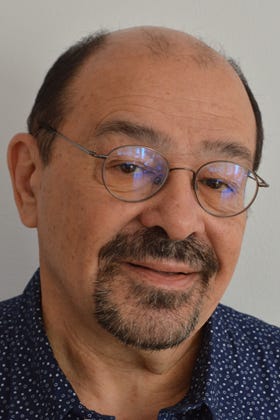
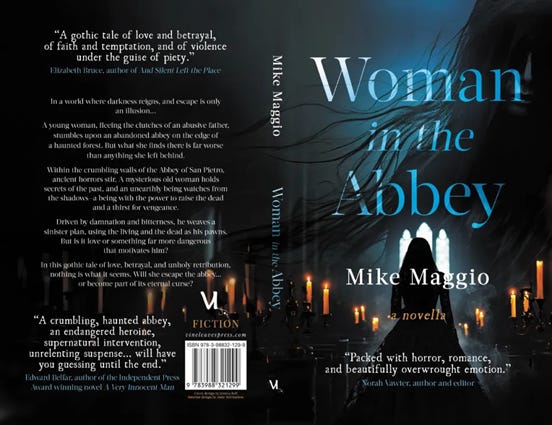
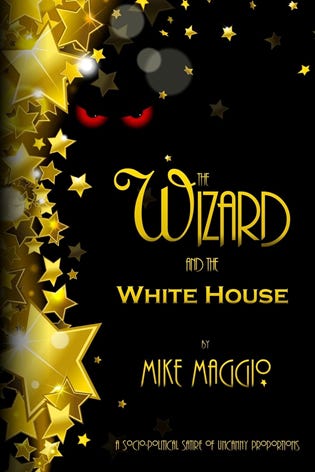
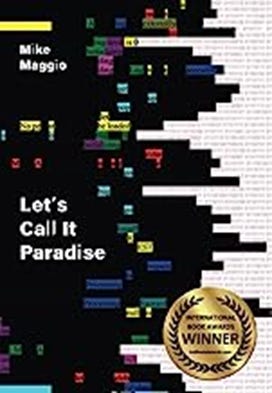
Mike Maggio’s publications include fiction, poetry, travel, reviews and translations in local, national and international publications including Potomac Review, The L.A. Weekly, The Washington City Paper, and The Washington Independent Review of Books. His full-length publications include a novel, The Wizard and the White House (Little Feather Books, 2014), a novella, The Appointment (Vine Leaves Press, 2017), and a collection of short stories, Letters from Inside (Vine Leaves Press, 2019). A full-length collection of poetry, Let’s Call It Paradise, was released by San Francisco Bay Press in 2022 and won the International Book Award for Contemporary Poetry in 2024. His latest publication, a novella entitled Woman in the Abbey, won the Literary Titan Gold Book Award in 2025 and was a finalist in the 2026 Maxy Awards. Forthcoming in Fall 2026 from Bordighera Press is a bilingual collection of poetry, edited by Maggio, with poems from Italian and Italian-American poets in translation. His web site is www.mikemaggio.net
1. How do you enter your characters’—or poem’s--subjectivity? What does that process look like? Do you prefer certain points of view in your writing—first person, close third, etc.? How do you handle multiple or alternative POVs?
This is a very interesting question, one that applies to both poetry and fiction (as you know I am both a poet and a fiction writer). I think the answer comes down to voice. Every story and every poem has its own voice. Similarly, characters have their own voices. The job of the writer is to find those voices and to render them as authentically as possible.
For me, story is an extension of character. Without character, there is no story. There are two levels, so to speak, to this. One is the overall voice of the story which the author has to find. When I was writing Woman in the Abbey, it started off as third-person. Instinctively, I knew this was wrong, and I eventually switched to a first-person narrative which carried much more power and was just right for the story.
When I am writing a story (or a poem for that matter), I am connected to something outside of me. Some people call it channeling. I connect not only to the story but to the characters in the story. I hear them speaking – each one with a different voice, each one with a different persona. In a sense, I am transcribing what I hear. This is the second dimension to a story: the voice of each character.
At the moment, I am working on a novel for which I have not found the voice, though I have found the voice of some of the characters. And if I don’t find the voice of the novel, I will probably abandon it.
As for handling multiple POVs – this is a hard one. I find it easier to do that in separate chapters. And yet, within an individual scene, you can do this through dialogue or perhaps through using stream-of-consciousness. The difficulty is in making sure the reader knows which POV is being rendered at any given time. Otherwise, there will be confusion. On the other hand, confusion is sometimes the goal.
2. Tell us about some of your characters. Where do they come from? Do you have favorites? Do you ever feel a sense of duty toward your characters to complete or honor their stories?
My characters come from imagination. Perhaps that’s the easy answer. But ultimately, characters come from the story itself. My first novel, The Wizard and the White House, is a political satire which involves the President of the United States and his cabinet, some members of Congress, an African-American who works as a porter at Union Station, his wife, Pearl who, unlike her husband, is a church-goer, and her paster, Reverend C.J. Willis. In addition, there is a Pakistani couple, Fuzzaluddin Choudry and his wife Amina. In a sense, all of these characters are caricatures, though they are much more fully developed. The novel deals with racism and political and social class as well as with immigrants. In order for the story to work, this mix of different individuals from totally different backgrounds – a President who is from the ruling class, an African-American from the working class, and an immigrant family from a third-world country – needs to come together in some fashion and interact, interactions that might not otherwise happen. It’s these interactions that form the basis of the story and that create not only political comedy but also social commentary.
I don’t know that I have favorites, but Fuzzaluddin (aka Fuzzy) and Amina are such interesting characters as are Pearl and the Reverend Willis. And their motivations, which are sometimes opportunistic (Reverend Willis, a local preacher, seeks to become the pastor of a megachurch, and Fuzzy is always filching from his charity boxes), are what drive the story.
I don’t know that I have a sense of duty towards my characters. They really are their own persons, and I’m just there watching them and recording their actions.
Woman in the Abbey provides a different perspective, so to speak. As mentioned above, the story is told in first person, and the narrator is none other than the devil himself. This provides an interesting aspect to the story because, as you know, first-person narratives are, by their very nature, biased, and when the narrator is the devil: well, you don’t really know what to believe. And so this creates an added tension to the story, an added dimension. He tells us his story, but there’s always this doubt in our minds about whether what he says is sincere. The editor kept pointing these discrepancies out to me, and I kept telling her that that was the point.
3. What are your overarching creative objectives—capturing perception, voicing a narrative, shaping aesthetics? Do you set external goals as a writer—publications, residencies, audiences?
First, I don’t set external goals. I don’t write for a publication or an audience unless, of course, I am applying for a grant. But tailoring your writing for a specific publication is kind of deceptive, I think. I guess the question is: who do you write for, yourself or some other? And then the questions becomes: how honest are you with yourself as a writer? What is it you are trying to accomplish? Where is your humility or are you approaching this through arrogance?
My creative objective is to create something that is pristine but, also, something that takes me and the reader to someplace we’ve never been to. As a writer, I thrive in the imaginative world. It’s a process of discovery. It’s that discovery that guides me and pushes me forward. This relates to both story as well as to place and to character. I try to imagine the unimaginable. That’s what keeps me going. I don’t think I could write a straightforward, realistic novel.
Now poetry is a different story. My poetry sometimes stems from reality: things I observe or events from my own life. But then, that has to be translated into something poetic. This involves, for me, both imagery and sound. My very first creative writing class, as an undergraduate, was with a teacher (Stephan Stepanchev) who emphasized image. And that has been my primary approach ever since. Combine this with my studies in Linguistics, later, as a Master’s degree student at USC, and now you have the fundamentals of poetry, or at least my poetry. Because I have a deep understanding of how language works. And I combine this with my knowledge of prosody. This is a powerful combination that allows me to do things I would not be able to do otherwise. These two form the basis of my aesthetics.
Do you strive to explore the human condition—especially aspects others might find disturbing or strange? Have you ever felt a moral imperative to write something difficult or painful on behalf of others who can’t?
This is an interesting question. I was just at a commencement ceremony for my son at Juilliard, and the Dean, who presided over the ceremony, said that artists of all stripes need to put the human back into humanity (or it could have been the other way around). This is a statement I’ve been thinking about ever since. I think it sums up what we do, whether as writers, musicians, visual artists, or actors. We are depicting the human condition as it unfolds before us. It is a duty – a responsibility that we cannot shirk.
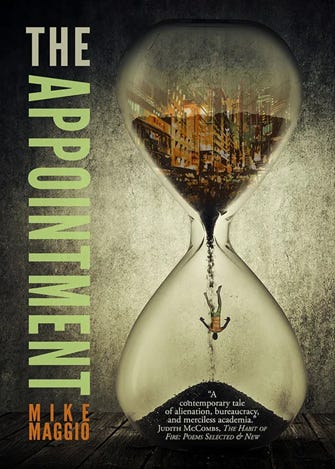
I don’t believe I’ve written something on behalf of others. I don’t know that I can because their pain is personal and who am I to try to render it on paper? It would be presumptuous of me to try to understand what they are going through unless, of course, I have spent a great deal of time with them. My approach is different: not on a personal level but on a societal level. Hence, some of my political stories. Or stories that takes their cue from Kafka or Gogol whose stories explore the human condition in absurdist ways. My novella, The Appointment, is a case in point. It’s a story of alienation and of emotional and physical death. Here is an excellent, in-depth review of that book.
5. What kind of training have you had—formal or informal—and how has it influenced your writing life? Do you see yourself as a mentor, teacher, or coach for others?
My training is wide and varied. I have a Bachelor’s degree in English from Queen’s College (CUNY) with a concentration in Creative Writing. Back then (in the early 70’s), it was one of those rare programs that offered creative writing as a major. As I mentioned above, I have a Master’s degree in Applied Linguistics from USC. In addition to its focus on linguistics, there was a heavy emphasis on pedagogy, and so I am trained as a teacher, something I’ve done most of my life, including now as I offer online creative writing classes. Lastly, I have an MFA in Poetry from George Mason University. This degree not only gave me a deep understanding of prosody but also allowed me to explore literature in-depth once again.
All of this has had an effect on my writing. However, more than that, I have also seen myself as a teacher and mentor, and I believe that is evident even when I’m giving a reading. I am always trying and ready to mentor people.
6. Do you have an ideal reader in mind? Who is drawn to your work, and why do you think that is?
I view what I write as literary. It is serious writing but there is also a lot of humor. I would hope that my writing is accessible to a wide audience, but I always see an educated audience, one that is steeped and interested in literature, as my main target.
Frankly, I have no idea who is drawn to my writing or who is reading it. It’s a question I would love to be answered. But for those who are reading this interview, I would say: if you like Kafka and Gogol, if you like absurdist literature, if you are drawn to language (think Faulkner) or stories that intrigue, then by all means pick up one of my books.
7. In show biz, an artist’s life is a study in rejection. How do you sustain your confidence and faith in your own artistic and career development--how do you hold your own hand--when faced with rejection and disappointment? What keeps you going?
Another interesting question. I can’t tell you how many times I have gone into depression because of rejection or lack of recognition. But ultimately, I pick myself up and go on, realizing that I write for myself first and foremost.
Rejection, as I like to tell my students, is a badge of honor. When they were physical pieces of paper, I would save them. Now, I just delete them. But one needs to understand what rejection means. And it does not always mean that your work is unworthy. It could simply mean that the poem or story you have submitted does not fit in with that particular journal or even with a particular issue of that journal. And so, many times, you’ll get a note that says “please consider us again in the future.” They are not just being nice. They are indicating that what you sent did not quite fit in at that moment but that it was, nonetheless, worthy. I know this because I am an associate editor for a journal.
So you received a rejection today? Don’t be upset. Put it in context. Curse, if you need to, and then move on.
8. Please tell us about one of two historical events that had a significant effect on your creative life, and how so?
1. The George W. Bush Years
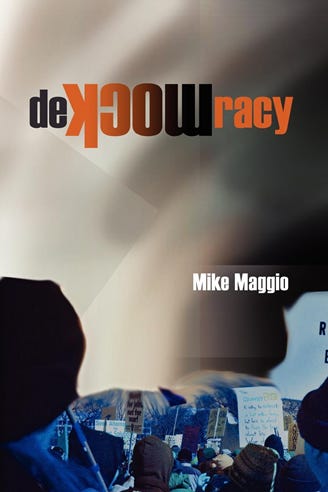
The George W. Bush years were times of protest and war: the Iraq war which was sold to us under false pretenses. One protest, which was on January 18, 2003, took place on the National Mall on a brutally cold day. And yet, the crowds showed up and, I can say in all honesty, that we did not feel cold. There was even one protestor there who wore nothing but his jockeys and had a large peace sign tattooed on his chest. (A photo is in my book deMockracy).
How did this spark creativity in me? For one, I documented all of this with my camera. I then put together deMockracy (Plain View Press, 2007), a collection of anti-war poetry (a screed in many ways), and included many of the photos I had taken.
Later, I would write The Wizard and the White House (Little Feather Books, 2014), a political satire based on the Bush years.
None of this would have happened without the politics of the era.
2. The Donald Trump Years
I can’t really say that the Donald Trump years have inspired me other than with anger. However, one short story has come about as a result: “The Naked Man.” This story was completely inspired by the absurdism of our currently political environment.
One other event that inspired creativity during this time (and really at the end of the Biden administration) was the war in Ukraine. As a result of this war, I created a performance piece, “La Guerra è Pace La Guerra e Pace” which was performed in Naples, Italy, in 2022. It was a bilingual collaboration with local poets, actors and musicians.
9. What advice do you have for other writers and artists on how to sustain their creative practice?
You need to have a schedule. Make it daily. Make sure you have set aside the time to create and don’t let anything else interfere. When I was writing my first novel, I decided to get up each morning, Monday through Friday, at 4 AM and work before leaving for my day job. It was difficult, at first. I was bleary-eyed. I couldn’t really concentrate. But I soon fell into the habit and when I missed a day for some reason, I felt as if something in my life was missing. It became part of my routine. And it allowed me to write several novels and put together several collections of poetry.
This is really important. If you are serious – if writing becomes equivalent to survival (intellectual or other) - then you will do it.
I would also recommend joining a writing group. But choose carefully. You want honest feedback. Not someone who tells you your writing is great without substantiating that. Or what you’ve brought to the group on that particular day is not good. Take criticism but take it carefully. Learn who to trust. And, above all, learn to trust your own instincts.
Writing is a journey. Like any journey, you will meet obstacles. Obstacles are challenges. Meet the challenge. You will be better for it.
For more information about Mike Maggio and his many books, please visit his website at: www.mikemaggio.net
poem by Mike
Plexus
by Mike Maggio
within the absence
of absence
outside the luminosity
of existence
lies the likeness of a water lily
filigreed on a momentary lake
the pale echo of a morning bell
skittering across an unknown sky
existence
crystalized
into
absence
now
a distant glimmer beckons my unshrouded soul
in an instant
my brief spirit waxes into white
sealed within this brilliant bead of water
pulsing outside my winter window
Published North of Oxford, Winter 2026
What a fabulous interview and a peek into my mentor's writing process and philosophy. Well done!