A Transcript of our Conversation with Shalinee Gusain
with Hosts Elizabeth Bruce and Michael Oliver

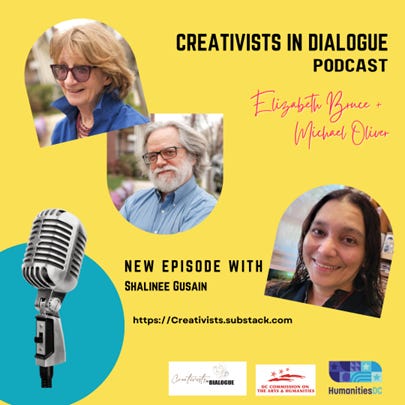
If you would like to read a transcript of our conversation with Shalinee Gusain, you’re in luck. Below is the opening with a link to the whole conversation here.
Shalinee is an early childhood educator, a parent, and a lifelong learner. She is fluent in English, Hindi, and Telugu and is currently learning Spanish. After earning her Ph.D., she moved from India to DC in 2007. Ever since then, she has worked tirelessly in education as a parent volunteer, a gardening teacher, an environmental science educator, and is now working in a SPED (special education) classroom.
In 2003 at India’s Jawaharlal Nehru University, Shalinee published her dissertation, ”Feminist Contributions to Indian Sociology: A Study of Select Texts.”
Her scholarship drew from the works of historian Tanika Sarkar, as well as eco-feminist Vandana Shiva and anthropologist Leela Dubey. Shalinee attributes her learning to the University of Michigan social psychologist George Herbert Mead (1863-1931), as well as educational thinker Eric Erickson’s developmental stages and Howard Gardner’s multiple intelligences theories.
As a teacher, she strives to create healthy socio-emotional settings that foster learning experiences for the whole child, while still bringing her own experiences to the classroom and the community.
To find out more about Shalinee, click here.
Elizabeth: [00:00:00] Welcome to Creativists in Dialogue, a podcast embracing the creative life. I'm Elizabeth Bruce.
Michael: And I'm Michael Oliver.
Elizabeth: And our guest today is Shalinee Gusain, who is a science educator, a social scientist, a parent, and an immigrant from India. Welcome, Shalinee. So we have a couple of questions that we generally start with—
Michael: —and the first one is this. In what aspects of your life would you say that creativity has had the greatest impact?
Shalinee: Thank you Michael and Elizabeth. I am very privileged, feeling privileged for being in front of you. And this is the first conversation I'm having about creativity and—
Elizabeth: Well, we're delighted to have you here, Shalinee.
Shalinee: Yeah, yhank you so much for inviting me for this dialogue. I would start from the very early life of mine, like, childhood. I grew up in southern part of [00:01:00] India where the whole community is celebrating at any point of time. We as children are exposed to a lot of input from the society, school, home, and children themselves when they're playing around. That gave a lot of input for me.
So if I had to start, when did you start your own first creative thing? It's in the playground. It's in the playground with my fellow children, most of them like boys and girls playing together and creating our own place. In India when we're going to play, it's actually a game, in American context. And we have our local language, Telugu. I speak the Telugu language—
Elizabeth: This is your native language?
Shalinee: Native language, the first language, Telugu, which I speak with my friends. And then in the school we were taught Hindi and English as part of the curriculum. So, in the house we speak Deccani, Deccani [00:02:00] Hindi. Regular Hindi and regular Urdu are having these words, but Deccani Hindi is an adaptation of mixing Telugu in between. So, it has the grammatical structure of Telugu with Hindi and Urdu words.
Elizabeth: Wow. That sounds complicated.
Shalinee: Sounds complicated, it doesn't sound—but it's a good mix of culture. It's not on the crossroads of two or three cultures, but when it came out like this. Deccani.
Elizabeth: Wow. Wow.
Shalinee: So, at home, me, my mom, my dad, my brother and sister, we all speak Deccani, but when I step out in the street, I'm speaking Telugu, English, and Hindi.
Elizabeth: Okay.
Shalinee: English is inevitable in school because they used to just penalize us for speaking non-English words.
Elizabeth: Oh, it was—
Shalinee: It is like a penalty. So, they were like, “You have to learn English”.
Michael: So, were you constantly like weaving the various languages together when in conversation?
Shalinee: Yes. So, the, when there is a [00:03:00] weaving of conversation, that's where comes the part where, what would you say this in Telugu? And what would you say it in Hindi? What would you say it in English? And by going back home, how does you say it in Deccani?
When we are listening to the songs in radio, we used to distort the songs. “This is what he was trying to say, miss.” “No, this is what he said.” And I used to translate it to my mom. My mom used to say that. “What did he just say in Telugu?” We were like communication for her—my mom speaks only Hindi, Urdu, and Deccani, so, “What did he just said in English? What did he just say in Telugu?” So in the part of translating it to mom, so we—me and my sister mostly—used to translate it to mom, is becoming a task to the point, like, we started translating everything, including songs.
Elizabeth: Wow.
Shalinee: That's where the creativity came. Okay. Listen to the song. My sister used to listen to the radio and there was some favorite songs she used to make note of [00:04:00] the lyrics. And I used to feel bored with those lyrics because none of them are my language. So this is what they would sing in Deccani and I used to quote unquote “distort.”[MM1]
Elizabeth: Okay.
Shalinee: So that's how the creativity has begun.
Elizabeth: Wow. So you were a translator, an interpreter, a rewriter of song lyrics.
Shalinee: Yeah. Unintentionally. Unintentionally. Like it has become a like boring, turned into creative.
Elizabeth: Yeah. Yeah. It sounds amazing.
Shalinee: So it's like trying to find a life hack.
Elizabeth: There you go.
Shalinee: Instead of complaining, “This is what I would do, blah, blah, blah.” Rolling their eyes, but it was going into certain direction.
Elizabeth: Wow. Translation itself is an extraordinarily creative process.
Shalinee: Yes.
Elizabeth: I have a lot of friends who've—
Shalinee: Without losing the spirit of what is being said—and I want to make sure that my mom knows what's going on around in the street—basically it could have been a good tattling experience. [00:05:00] “Mom, this is what happened.” But she is not the person who is judging. But I just want to share with mom is a big deal for me. “This is what happened.” So when it is describing into mom, it's in Deccani.
Elizabeth: Wow. So you have all these channels open—
Shalinee: Open.
Elizabeth: You have this language channel and that one and—
Shalinee: Three!
Elizabeth: Three language channels—
Shalinee: Three coming from outside—
Elizabeth: —simultaneously—
Shalinee: —getting into, when it's going home, it has to summarize into one. So that’s—
Elizabeth: Wow. Talk about synthesis.
Shalinee: Synthesis. So that is the thing, which is like, it has become a passion for me. When I'm going to tell mom, “This is what I would do.” So it is going on in the back of my brain.
Elizabeth: Wow. So you, even while you're taking in information, content, experience in these three different languages, you're rearranging information in your—
Shalinee: Back of my brain.
Elizabeth: Back of your brain. Wow.
Shalinee: And that has set my default. So now I'm wired to the point like, Mom is not there, dad is not there, I have to take [00:06:00] notes. So unless I write it down, yeah, I cannot process it. It has come to that point. Like, okay, I had to make a note of it. I'm never going to refer to that note.
Elizabeth: Sure.
Shalinee: I know it deep in my heart. But it has to go onto the paper.
Elizabeth: So I'm like this, I have to write things down and then I have to see them and I can visually remember—
Shalinee: Yes.
Elizabeth: —something, if I look at the page and it's “Oh, it's in green ink, it's in the upper right-hand corner.” I can remember.
Shalinee: Ditto with me. And it's a back of the envelope, back of something, which is—I'm like scampering, like this. Where is the paper? Where is the paper? And in the back of the envelope, it is full of rectangles. Rounded up. One connected to another. So it looks like messy to people who are just looking at it. “What's going on?’ But I have a meaning for it.
Elizabeth: I know. It's like my to-do list should really belong in the Visionary Art Museum.
Shalinee: Yes. Yes. So that is very important, paper, for me. So when I'm cleaning the closet I know that there are papers from 2014. [00:07:00] It's like a time travel for me. There's a little time capsule. I can recall everything what happened on that day, including the dress I was wearing, this is the way she was doing, everything.
Elizabeth: Wow. So it's almost like you have an, is it called an eidetic memory? A photographic memory?
Shalinee: Photographic memory. It's like time capsule. So, my house looks like a mess. It's never been organized. And I feel very nervous when I'm organizing. I know something is going to happen. It's like an anxiety built up over the time. So, then I realized, okay, let me do it whatever feels comfortable without hurting anyone. Without hurting anyone. So I'm always asking, “Are you good? Are you good? Are you good?” Okay. You leave me alone and from here I can
Elizabeth Wow.
Shalinee: Put my brain.
Elizabeth: That sort of leads into one of our other questions, which is about how you understand creativity itself. You've been telling us quite a bit about creative problem solving, but how do you personally view creativity or the creative act?
Shalinee: It is all about focus. If we want to summarize [00:08:00] what is creativity in one word? I would say focus. Not just focus where you have, okay, you’re-staring-out-at-the-art-on-the-wall focus. Like you connect to it to the point, like, you-are-in-a-total-immersion focus.
Elizabeth: In the zone.
Shalinee: In the zone. That's the most closest word I can say it in English. Because there is a collateral word, but how do you say...
Michael: Well, Csikszentmihalyi uses the word “flow.”
Shalinee: Flow. Yeah.
Michael: When you're completely immersed and—
Shalinee: Concentrating.
Michael: —one with your subject in a sense.
Shalinee: Almost like meditation. In Hindi, we call it Dhyāna (ध्यान). Like you put all your brain into it, and you are not concluding a, snap, “okay, come on, let's pack up and leave” kind of conclusion. You are contemplating it over a period of time, not just an hour or so. It is like second day, third day, fourth day. Version one, version two, version three. It's a work in [00:09:00] progress. By the time you say you have come to the conclusion, it is like a big pile of alternative chunks of paper filled with blobs. It's not a linear thinking, it is like a radial thinking. You are in the center and you are going into situations. What if that? What if that? So, in, mentally it is coming from where, okay, if I have to talk about this to my mom, I would say this is this in this language versus going back to school, if the teacher asked me, what did you do last night or last day, my version will be different.
Elizabeth: Okay. I love your term. Radial thinking.
Shalinee: Radial thinking. Right.
So when it comes to creativity, it gives lot of stress to say, “Why did you just said what you said?” I can't explain. Because the moment I'm talking to someone who is a different person, who is not my mom, obviously my audience has changed. [00:10:00] So I'm making sure the whole narrative is friendly to these ears versus my mom. My mom is very informal. She says,
“Okay, just be quiet. I'm focusing on cooking.” I'm immediately, I'm withdrawing, I'm accepting that without feeling, “Oh, I'm wanting to share with her now.” Versus with other audience, I say, okay, this person asked me a question. I feel the obligation of sharing to the point, say, okay, “We are good. We are good. We are good.” So that stops me. “I wanted to share this one, this is the most important part!” But this person is not ready.
Michael: So translating that is moving into the sort of the educational sphere. And when you're thinking of creating a lesson plan that's going to engage 20 students in a classroom—or 15 or 25, whatever the number is—obviously each of those students has their own sort of mindset, their own sort of cultural factors, et cetera. Can you maybe talk a little bit [00:11:00] about the creation of a lesson plan and what goes into that? And what are the factors you need to consider?
Shalinee: Yeah, that's what I was planning to find out. Who is ready? That's what I was about to say.
So now it's not my mom anymore. I'm not a child anymore. So anything which I want to share, I have to regurgitate to suit the years of my audience, who are three-year-old, four-year-old at the max. Early childhood education goes from pre-K3 to second grade. According to DCP and US educational standards and all that.
So I am going to recall what I was doing as a three-year-old to second grade. I have a very vivid memory of how I was when I was two and a half years old. Very vivid memory. I used to nag my mom to pick me up when she was talking. I used to crawl all over her, to, all I wanted was to hug her. Staying physically close [00:12:00] to her. So then I realized, okay, when I am able to remember this much, that child who is in front of me, a three-year-old, is going to remember exactly that. They have very good memory. I believe in that. So, when I'm going to leave them— “Bye and see you, goodbye!” —and all that, when they won't see me anymore, I'm going to leave a vivid memory to them. So that is my motive. So when I want to be, even, no matter how brief the conversation is, I'm not going to leave them with, “Oh my God, this is a woman whom I'm trying to be scared of.” I would leave a memory for that child to carry something to cherish. “I want to meet her again!” So that is my motive.
I'm not the only teacher in their lifetime. They're going to meet hundreds and thousands of teachers, learning situations. But that is my motive whenever I meet a child who is a three-year-old or any age group any person whom I call a student, child because they have a lot of intellect, [00:13:00] I believe in that.
CLICK TO READ THE WHOLE TRANSCRIPT
To those of you who are FREE subscribers, please consider becoming a PAID subscriber so that Creativists in Dialogue can continue bringing you interesting and insightful conversations about creativity from DC and beyond.
Special shout out to Creativists in Dialogue’s Audio Engineer Elliot Lanes, our Social Media Manager Erinn Dumas of Dumas83, and our Transcription Editor Morgan Musselman.
For more information about Creativists in Dialogue or our other projects, please visit elizabethbruceDC.com or Rmichaeloliver.com.
This project is supported both by the DC Commission on the Arts and Humanities and by subscribers like you.