A Transcript of our Conversation with John Chambers
with Hosts Elizabeth Bruce and Michael Oliver

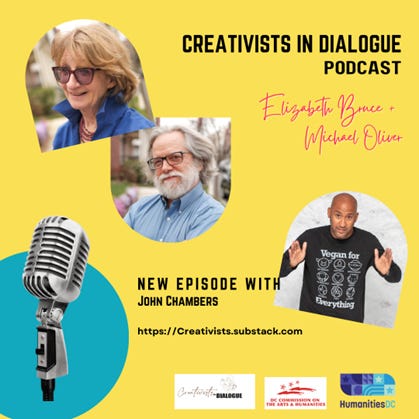
If you would like to read a transcript of our conversation with John Chambers, you’re in luck. Below is the opening with a link to the whole conversation here.
John, who is originally from Massachusetts, is a Howard University graduate with an illustrious history as a global communications professional, working on issues of national importance. He left that field to found the extraordinary organization, BloomBars, an award-winning community arts nonprofit that is a creative incubator—home and sanctuary to people of all ages and stripes in Washington, DC. John is also an incredible father, a passionate vegan, a creative writer, a visionary entrepreneur, and a beloved advocate for the healing power of arts and community.
For more information about John and his community, click here and here and here.
Elizabeth: Welcome to Creativists In Dialogue, a podcast embracing the Creative Life. I'm Elizabeth Bruce.
Michael: And I'm Michael Oliver.
Elizabeth: Our guest today is good friend and deeply creative colleague John Chambers. John, who is originally from Massachusetts, is a Howard University graduate with an illustrious history as a global communications professional working on numerous crisis issues who left that field to found the extraordinary organization BloomBars, an award-winning community arts nonprofit that is a creative incubator, a home, and sanctuary to people of all ages and stripes in Washington, DC. John is an incredible father, a passionate vegan, creative writer, visionary entrepreneur, and beloved advocate for the healing power of arts and community. Welcome, John
John: Thank you. [00:01:00] Thank you. Although that felt like an obituary. I should just stop right here. Thank you.
Elizabeth: John is very much with us.
Michael: Alright, so we like to start off our interviews with a couple of questions. The first one is this: In what aspects of your life do you see creativity as having the greatest impact?
John: What aspects of my life at present—
Michael: Throughout your,
John: Throughout my life?
Michael: Yeah.
John: Yeah, I think just thinking about problems differently. I think the end result of creativity is creation, and I think about art as the way that creativity tries to achieve its fullest potential.
Michael: So whenever you run into a problem, that’s when you—
John: I think of creativity means so many things to so many people. I think there's creativity in everything. There's creativity in everyone. There's creativity in science, there's creativity in every field that we study. People express it differently. [00:02:00] We just call it different things. I think, there's inspiration, there's muse, there’s the idea that our ancestors are present, which I think of, about, about a lot. Some of these things actually, I think our ego tells us that they came from us, but they actually came from some ancestor whispering something in our ears that we just need to be in the right, a right space to receive.
Michael: So it sounds like your whole life is just infused with creativity.
John: I think that's—
Michael: Which you try to—
John: Yeah, I think that started very early on, just having parents who were very different from each other, trying to carve out a place for themselves that is in the service of people, of humanity, and not necessarily putting money first and I think that crossed over to their parenting and how they wanted to raise their children and with a level of freedom and independence that allowed us to figure it out on our own, you know. But they're very different from the [00:03:00] children that they raised, I can say that for sure. I don't know. We're, all of us are creatives.
Michael: Oh, maybe we'll get into that.
John: Okay.
Michael: That difference.
John: Alright, sure.
Elizabeth: We, you've been speaking actually about, what we often ask our guests about, which is the different perspectives about creativity and how to extend and expand the definition of creativity to include, as you mentioned, a wide variety of human activities. Do you personally have a particular definition of creativity or was there a particular definition of creativity in your home growing up, in the community in which you were growing and becoming a young person?
John: Always. Always, I think from, from birth, I think it was just, I was seeped in different cultures. I was seeped in art from Africa, art from Europe, my mother and father coming from very different backgrounds, there was all this art everywhere in our [00:04:00] house. And it was, half of it was, my father spent two semesters in Ghana, and he had brought back nothing but art.
Elizabeth: Wow.
John: Stools and benches and—
Elizabeth: Textiles?
John: Textiles, yes! The whole thing. Offering many, much of it to my mother's family—
Elizabeth: Sure.
John: —as an offering to try to get into good graces. But yeah, we had, from the classic, Matisse and Rodin, posters—that, of course, didn't have the real ones—to my mother's.
Elizabeth: Oh, no Rodin sculptures in the living room?
John: No, no Rodin sculptures in our space. But we had these, seriously, we had these very ornate portraits of my grandmother's side of the family, with the gold leaf and the, painted by some portrait maker and chipping a little bit here and there, but sitting in my parents' library. So it's very interesting contrast. And yeah, they were always driving us, I think to, yeah, just do things creatively. Whether it was forcing me to play the piano and clarinet as a child or [00:05:00] just drawing and putting things in front of us that were challenges.
Michael: Following up on that, we like to go back into those early childhood experiences of creativity that are formative. Maybe if you could share one of those memorable experiences? Either as a participant or as a witness of where you felt empowered creatively.
John: Yeah. There's both happiness and sadness with the first memory that comes to mind. And it's when I, we had this play, and I was in the seventh and eighth grade chorus. And it was a solo, it was the All-American Express, so all the old timey songs and I was cast as the hobo. Go figure.
Elizabeth: Go figure.
John: Yes, but, hey, the hobo had two solos. So, I was torn, I'm like, “Yo, I'm the only Black kid in this school. Why do I have to be the hobo?” That's the story of my, of the town, of my childhood. But, but seriously I really felt this confidence in my voice and—this was before it changed—and, I didn't [00:06:00] sing as much, but I really just, that being in front of an audience and being able to create and feel a resonance coming back, I think was the first memory of me feeling, “Yes, I want—”
Elizabeth: That, that leads absolutely into one of the other things we wanted to ask you about. Because you have written, and you speak eloquently about growing up in a biracial family in an overwhelmingly white community in Western Massachusetts. And you've just referenced some of that. How has this demographic landscape informed your own creativity and your own creative momentum?
John: That's an interesting question. I think, as I mentioned before, there's a lot, there's a lot of, trauma in that, in those times, and some of it just comes, comes back at different times. But in general, there's a want for normalcy, a drive for normalcy. And I think during a large portion of my childhood, I found creativity in athletics and being, creative as an athlete, even though the rewards were much more, as a [00:07:00] community, as a society, in terms of acceptance. So I think I leaned into that and leaned less into the artistic side for a long time. But I always continued to see myself as a storyteller. And I wrote, as a child, I wrote journals. And, same with my sisters and I really, I gotta give it to my big sister was like, she was my lighthouse. I could never shine brighter than her, but I could try to, walk in her footsteps, whether they're conscious or unconscious. I think I did that for a while, moving into communications and journalism and trying to tell stories that, that move people, that impact people that, that build community at the same time.
Michael: And definitely it sounds like your family was immersed in various forms of creativity. You talked about the piano, you talked about your father bringing back this art from Ghana, and then you found creativity in sports. How did your family view the creative person? Was there, was it an organizing principle or was it more of a, [00:08:00] something that is for the privileged?
John: No, I thought, I think my parents gave us all a sense that creativity was for everyone, and it was accessible. And it was to be revered and great artists were to be revered, great writers were to be revered as this, the fullest expression of a thought, an art, an art form. Again, from the, from the visual artist to the poetry my mother loved and continues to write to this day, she's just, she loves sharing her poetry, and she writes a lot and I think that's a big influence. But I think, creativity in the service of change, of positive change, of societal change has always been ingrained as how I think about creativity. That it's purposeful. Not every, every creative thought or anything has to be in the service of others, but that just happens to be what makes me find purpose here on this earth.
I think the pandemic made me look inward in a lot of ways. And the loss [00:09:00] that, that I've experienced, my family's experienced, also has caused a lot of inward thoughts. And creativity is a big part of that. And I think when you go back in time and you're able to express, like you said, through essay or through memoir and break through that, that third wall of your curation, the curation of yourself as a creator.
And then I think you gain access to another form of creativity once you're able to really tell your story and understand who you are more and how you tell your story. And I think that's part of the growth and that's part of—coming to the understanding that it's limitless and that there's no height that we've, can achieve that says that we've reached our fullest creative potential. Because we don't know that, and we don't know that unless we try.
And that's why I think this, and my whole purpose in life is to help people see that and help people express that. More in the form of movement for change. But certainly, just as individuals, how do we reach our fullest potential by just thinking differently about each other? About the ways we can get things out of each [00:10:00] other.
Elizabeth: As a writer, and I loved what you said about writing and how you can name your experience, you can claim your experience, you can restructure your experience and there's power and agency that comes from that. And you've also written movingly about the summers that you spent with your father's family in Chester, Pennsylvania, which is outside of Philadelphia. So this side of your family, which is African American, settled in Chester as a part of the Great Migration of Black folks out of the American South. You've written about how accepted and at home you felt there in contrast to the otherness you felt in your majority-white hometown in western Massachusetts. So, can you talk about how this differential between acceptance and alienation shaped you and your creativity?
John: I think it, it created sort of an inert personality that was able to [00:11:00] shapeshift in a way in different environments, just naturally being able to connect with people on a human level, rather than, this is, we're of the same status or so forth. But to really understand, try to understand the nature of people through more than just their words, but their actions and just the feeling that you get spending time around people that, you know, it's not time wasted. And I think that's, yeah, that's important.
Elizabeth: Sure. Among the things you talked about shape shifting, and you've also written about code switching in your writing from this small western Massachusetts town to a more urban speak in Chester, Pennsylvania. So, can you talk about code switching as a, a birthplace of creativity, of creative voice and range?
John: Yeah. It, it definitely is a, there is a creative process there. But again, I think it doesn't happen consciously. It's just a process—you're, partially a product of your environment and partially the need for normalcy, the need to [00:12:00] fit in amongst the group. But to, to also, again, recognize your different and how you're accepted differently and on what terms. ‘Cause it's not always on your own terms, sometimes you have to meet someone somewhere just for the sake of you are holding space together.
And I think when I was in Chester, I just felt a sense that I had never felt before. Because I had always felt, and it's funny, I told you I just had a visit from some cousins I haven't seen in a setting outside of a funeral or a wedding or some big event in several years. And they thought I had it bad because I wasn't accepted in either world. And they asked me how I adapted, how, what was that like. And I told them what you already know through, through my essay, is that I actually felt much more at home there. And I felt safe. I felt, despite it being the murder capital of the world or the United States at least at the time, per capita. But I think part of that was just the history of my family that they had there. There was a real strength in the, my father's side of the family [00:13:00] and the acceptance of my mother. They accepted her immediately. My, her niece, my mother, my cousin, she remembers my mother as just this, her embrace.
Elizabeth: Wow.
John: That was it. The, her, the first thing. And she never changed. She never wavered and she was just so wonderfully accepted in my house. And, to hear my cousin and I—you frown at people that say, “I'm colorblind” or, “I don't see color.” And it's, ah, it exists! But here I'm hearing my family say, “We never saw color with your mother.” And I understand that. But at the same time, I recognize she's always been the most wonderful ally without saying she's an ally, it's just who she is.
Elizabeth: Sure. She's just—
John: I think that's how she was raised. She came from privilege, and she renounced that to give her life to service. I think a part of that was in response to her, her privileged upbringing.
Elizabeth: Speaking of color, you've also written about aesthetics. You've written about the differential in your skin tone in [00:14:00] Chester versus western Mass and the high status or low status and all of the complexities of that. So is there an awareness of aesthetics that informed your creativity or the creativity of others based on this very personal understanding of other people's standards?
John: I think so. I think less so as I've gotten older and have my own sort of aesthetic and idea. I think it's true they say when you get older, you, you start to change less. That imprint is there. And that the imprint developed for a while. And, yes, I think for a while it was very popular to examine and explore the popular aesthetic and have that be your initial experience. But I think I've, I've been fascinated by every aesthetic in life, in people, as well as in, the creativity and the art that I've decided to have myself around me.
Elizabeth: Sure.
John: And I think, it's reflected in what BloomBars is, going back to this creation, this [00:15:00] idea and the creativity that, that it's brought with it, I think is a part of that, is a part of that story, is a part of the story that I'm continuing to tell. That's my life, that I'm just living. It's a story that we don't necessarily write, we live, right? But we also can write it and write it in different ways.
Elizabeth: Sure.
John: And try to write it in a way that moves people to understand their own experience differently in addition to our individual experience.
Michael: You also write about how the, I think it was the boardwalk was connected to a prison. And that there's, it's, there's a certain irony there. How do you see sort of contradiction and irony and the absurdity of the casino boardwalk leading to a prison or connected to a prison, how does that sort of manifest itself in your own creativity, your writing, or how do you use that?
John: Yeah, I think, we say contradiction nicely because we know there's really no contradiction and there's little coincidence in a lot of these, in a lot of these areas. And it's normally a funeral that I go to [00:16:00] in Chester with one of my dad's family members that are near all the chemical plants that shall not be named where my cousins and family have died from rare cancers. It's not a coincidence. It's not a coincidence that you go through a prison arch, that you feel like you're going into the prison, but it's actually the road to the casino. So yes, there's irony in everything, but it's really not irony. And I think when you're able to communicate sometimes in a way that uses the irony, not necessarily with the sledgehammer that says, there, there is systemic racism in every facet of our lives. It drives our system, it drives money, it drives our global imprint on the world. It's causing chaos. It's wrought havoc. What are we gonna do? I think it's a way to make people think about those challenges differently rather than with a sense of—what's the word I'm looking for—just, exhaustion.
Elizabeth: Exhaustion.
John: It’s pure exhaustion and unwillingness to [00:17:00] actually, make some major life changes. The adaptation that's gonna be needed in the future for our children. So I think the irony when I go back to Chester and I see the devastation, the, it's still alive in many ways and I still have family there, but, the house that my aunt and uncle grew in is a burned down shell now. There's one house there, my, my cousin's there. And I, and it's wonderful to read about, Chester doing well in athletics and all these wonderful people have come out of Chester. But it still just seems really sad to me to go through the space and realize that we, there, there's communities even in worse condition in this country that we're not addressing.
And I think how has that manifested in my own creativity? I think, initially I was very angry. I think when I was, towards the end of my experience in the small western Massachusetts town, I was very militant. I had come back from Chester, Pennsylvania with a Black Bart Simpson shirt, it's a Black thing, you can't understand [00:18:00], Egyptians were Black and I'm like I've read, I'm, I've, I'm knowledgeable, I'm into—and people looked at me like I was crazy. I was still in sports, so I was like accepted. I, it was never, but it was like John's on some Chuck D or something. I dunno what he's listening to. But I was angry. I was an angry Black man for a while. And I was still questioning and look searching for identity. I think that's part of the journey of coming from two very different cultures.
CLICK TO READ THE WHOLE TRANSCRIPT
To those of you who are FREE subscribers, please consider becoming a PAID subscriber so that Creativists in Dialogue can continue bringing you interesting and insightful conversations about creativity from DC and beyond.
Special shout out to Creativists in Dialogue’s Audio Engineer Elliot Lanes, our Social Media Manager Erinn Dumas of Dumas83, and our Transcription Editor Morgan Musselman.
For more information about Creativists in Dialogue or our other projects, please visit elizabethbruceDC.com or Rmichaeloliver.com.
This project is supported both by the DC Commission on the Arts and Humanities and by subscribers like you.